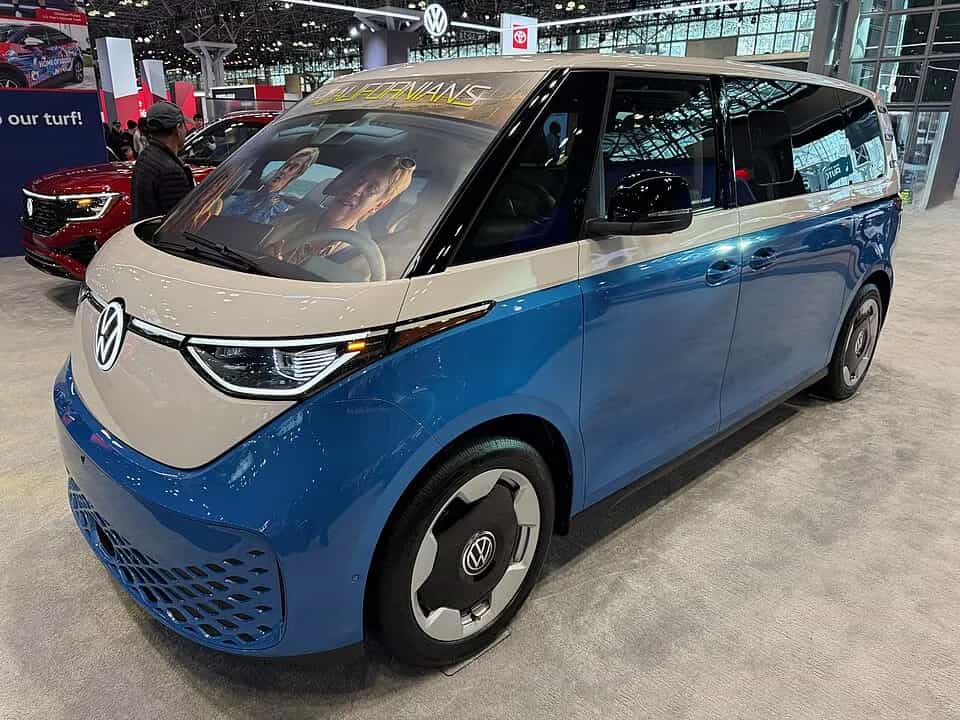
Volkswagen ID Buzz

USCar Trader import service

Import this model from the USA or Canada

Choose a specific vehicle. Where data is available, its detail page shows the import cost calculation. We assess any possible duty benefit with you before purchase.

Important: A 0% EU import-duty rate may be available for a vehicle covered by Regulation (EU) 2026/1455 that has US origin and is imported directly into the EU. CETA may apply to a vehicle with preferential Canadian origin. Whether the requirements are met is assessed for the individual case. Please contact us before purchase; we review the possible duty benefit and provide non-binding support through the process. Import VAT and other costs are assessed separately.

CarHub · Volkswagen

Volkswagen ID Buzz

The ID. Buzz is Volkswagen's electric reinterpretation of the classic Microbus, and the North American version is a very different animal from the short European van. For the US market VW built only the long-wheelbase, three-row ID.

Body
Typical US-spec ID. Buzz (2025, LWB): Long-wheelbase electric MPV/van (6–7 seats)
Powertrain
Typical US-spec ID. Buzz (2025, LWB): Battery-electric (BEV)
Battery
Typical US-spec ID. Buzz (2025, LWB): approx. 86 kWh gross (~91 kWh in some sources)
Motor(s)
Typical US-spec ID. Buzz (2025, LWB): Single rear motor or dual-motor 4Motion AWD
Volkswagen ID Buzz

Model profile

Model history and generations

From launch to today

Europe received the first ID. Buzz (short-wheelbase, five-seat, and a Cargo panel van) during 2022–2023. North America launched later, for the 2025 model year, and only with the long-wheelbase passenger version — a stretched body with three rows and up to seven seats.

Powertrain and equipment

Engines, drivetrain and trims

Engines and drivetrain in detail

The US ID. Buzz is fully electric. It uses an 86 kWh (gross) battery, with a single rear motor producing about 282 hp in rear-wheel-drive form, or a dual-motor 4Motion all-wheel-drive version making roughly 335 hp. Drive is through a single-speed transmission, as on all ID.-family EVs.

Trim levels and variants

The body is a long-wheelbase MPV/van only, with sliding rear doors and a choice of six- or seven-seat layouts (captain's chairs or a bench in the middle row).

Vehicle selection

North American market and suitability

Used availability in the USA

Supply is thin and fresh. Expect 2025 cars with low mileage — typically under 30,000 km (18,000 miles) — often loaded 1st Edition examples.

When importing makes sense

Buyers who specifically want the three-row, long-wheelbase ID. Buzz with the bigger US battery and more power, or who find a well-specified 1st Edition stateside.

Vehicle data

Technical data by generation and specification

Body and dimensions

BodyTypical US-spec ID. Buzz (2025, LWB): Long-wheelbase electric MPV/van (6–7 seats)
LengthTypical US-spec ID. Buzz (2025, LWB): approx. 4,960 mm (LWB)
WheelbaseTypical US-spec ID. Buzz (2025, LWB): approx. 3,240 mm
SeatingTypical US-spec ID. Buzz (2025, LWB): 6 or 7

Engine and drivetrain

PowertrainTypical US-spec ID. Buzz (2025, LWB): Battery-electric (BEV)
BatteryTypical US-spec ID. Buzz (2025, LWB): approx. 86 kWh gross (~91 kWh in some sources)
Motor(s)Typical US-spec ID. Buzz (2025, LWB): Single rear motor or dual-motor 4Motion AWD
PowerTypical US-spec ID. Buzz (2025, LWB): approx. 282 hp (RWD) / 335 hp (AWD)
TransmissionTypical US-spec ID. Buzz (2025, LWB): Single-speed
DriveTypical US-spec ID. Buzz (2025, LWB): Rear-wheel drive or all-wheel drive
0–100 km/hTypical US-spec ID. Buzz (2025, LWB): approx. 6.0–7.8 s (AWD/RWD)
Est. range (EPA)Typical US-spec ID. Buzz (2025, LWB): approx. 375 km (RWD, ~234 mi)
DC fast chargingTypical US-spec ID. Buzz (2025, LWB): up to approx. 200 kW

Model and other data

AssemblyTypical US-spec ID. Buzz (2025, LWB): Hannover, Germany

Values are reproduced verbatim from the existing article table. The documents for the specific vehicle govern.

Pre-purchase review

Model-specific inspection points

Reliability and common problems

As a very new EV, the ID. Buzz has a limited long-term track record, but it inherits the ID. family's known software behaviour. Early ID. models were noted for infotainment lag, occasional reboots and over-the-air updates that changed features, so confirm the car runs current software. The 12-volt battery and control-module wake states caused some early ID.

Germany and Europe

Differences, adaptation and registration

How US versions differ

The headline difference is size and battery: the US car is only the long-wheelbase three-row version with the larger pack, whereas Europe also sold a short five-seat van and a Cargo model.

From US purchase to registration

The right car and layout are selected, then the VIN is verified and battery health assessed.

TÜV, approval and license plates

Typical work is limited on a modern EV: European headlight/beam adaptation, adding or activating a rear fog lamp, a km/h display check and documentation of the odometer.

USCar Trader services

Inspection, purchase processing and escrow

As a buyer based in Germany, you do not have to inspect the vehicle yourself in the United States or Canada. Within the agreed scope, USCar Trader can coordinate document review, a separately commissioned on-site inspection and purchase processing.

  • Vehicle profile and history: The profile can show the VIN, US title status and available history records. No data source guarantees that every earlier event was reported.
  • Optional CARFAX report: Additional reported maintenance or service entries can be included. The report is not a complete service book or proof of every interval.
  • On-site inspection / USCT AutoCheck: USCar Trader can arrange a separately booked vehicle inspection. Agreed visible and accessible areas are documented. Road or functional tests require suitable access and seller approval; the visual review is not a lift inspection or workshop diagnosis.
  • Purchase processing and escrow: After approval, USCar Trader can coordinate seller contact, negotiation, contract and the escrow and import service. Fees, payment route and responsibilities are recorded in advance.
  • Recalls: Open safety recalls can be checked by VIN through the NHTSA recall search; they do not describe overall condition.

Covered inspection points are agreed in advance. An on-site inspection records condition at the appointment and is not a guarantee.

Next step: Before commissioning, USCar Trader and the customer agree which document, history, inspection and transaction checks suit the vehicle and are included in the service. This records what was actually checked.

Import process

Import, customs, costs and delivery

Process for the specific listing

The import process for a Volkswagen ID Buzz is planned around the specific listing, location, documents and commissioned service scope.

Questions and answers

Common questions about importing this model

Is the US ID. Buzz different from the European one?

Yes. The USA received only the long-wheelbase three-row version with a larger battery and more power; Europe also had a short five-seat van and a Cargo model.

When should USCar Trader be contacted before purchase?

Whether a duty benefit may be available for the specific vehicle is assessed individually. Please contact USCar Trader before purchase; we review the case and provide non-binding support through the process.

Does this vehicle automatically qualify for a 0% import-duty rate?

No, not automatically. A 0% EU import-duty rate may be available for a vehicle covered by Regulation (EU) 2026/1455 that has US origin and is imported directly into the EU. CETA may apply to a vehicle with preferential Canadian origin. Whether the requirements are met is assessed for the individual case. Please contact USCar Trader before purchase; we review the possible duty benefit and provide non-binding support. Import VAT and other costs are assessed separately.

What range does it have?

The rear-drive US car is EPA-rated around 234 miles (roughly 375 km); the all-wheel-drive version trades some range for performance.

How fast does it charge?

DC fast charging peaks near 200 kW, and US cars use the NACS/CCS arrangement, so an adapter may be needed at home.

Is it reliable?

The drivetrain is simple, but as a new model the main concerns are software currency and battery health rather than mechanical wear.

How many seats does it have?

Six or seven, depending on whether it has captain's chairs or a bench in the middle row.

How can a specific Volkswagen ID Buzz be checked from Germany?

Available VIN, title and history information can be reviewed in the vehicle profile. USCar Trader can also arrange a separately booked on-site inspection within a scope agreed in advance.

More vehicles